
Support for LGBTQ+ Equal Rights in US Among Non-LGBTQ+ People Now at All-Time High, Confirms GLAAD Study
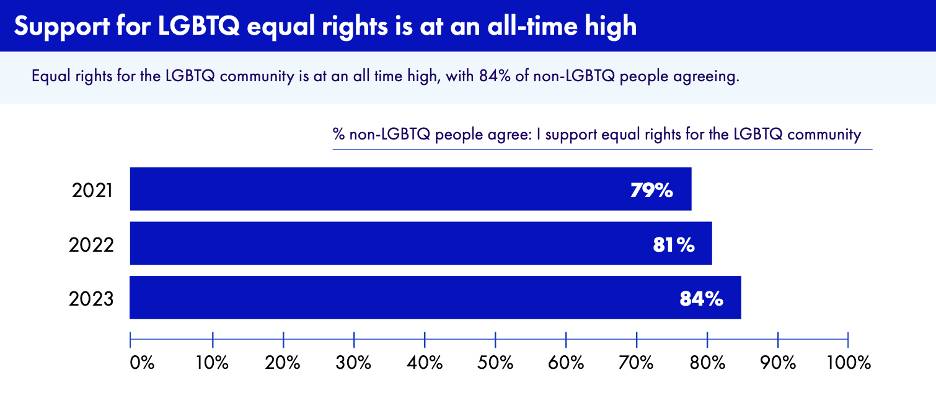
June 2, 2023A new study from GLAAD has revealed that support for LGBTQ+ equal rights in America among non-LGBTQ+ people is now at an all-time high. The study showed that the majority of non-LGBTQ+ Americans (84%) overwhelmingly agree that LGBTQ+ people should be free to live their lives and not be discriminated against, against a backdrop of rising anti-LGBTQ+ legislation and online hate.
The Accelerating Acceptance study also found that an overwhelming majority of non-LGBTQ+ Americans now believe that LGBTQ+ people should have the freedom to live their life and not be discriminated against, and that schools should be a safe and accepting place for all youth. "Any narrative claiming otherwise, goes against a statistical supermajority of consensus, public opinion and American values", stated GLAAD. The findings showed that:
· A 96% supermajority of non-LGBTQ+ Americans agree that schools should be a safe and accepting place for all youth.
· A 91% supermajority of non-LGBTQ+ Americans agree that LGBTQ+ people should have the freedom to live their life and not be discriminated against
· An 84% supermajority of non-LGBTQ+ Americans support equal rights for the LGBTQ+ community.
The study also directly correlates how the epidemic of anti-LGBTQ+ legislation and online hate leads to higher levels of real-world harm for LGBTQ+ people, including but not limited to discrimination and violence. Moreover, the study found that while acceptance for LGBTQ+ people and youth have reached record highs, the research also reveals a significant lack of understanding and familiarity for non-binary and transgender people.
Representation Matters
The study directly correlates insufficient visibility and representation in media and advertising for these communities of people to a lack of familiarity as individuals who comprise the LGBTQ+ community at large. This signals a heightened need to represent intersectional touchpoints of non-binary and transgender experiences across all media, from TV, film, publishing, journalism, gaming, advertising and more. When people are exposed to LGBTQ+ people and experiences in media, it changes hearts and minds and shifts culture and sentiment, noted the study. Measuring comfortability in media is a pathway to 100% acceptance for LGBTQ people, according to the report. The findings demonstrate that:
· 75% of non-LGBTQ+ adults feel comfortable seeing LGBTQ+ people in advertisements.
· 73% of non-LGBTQ+ adults report feeling comfortable seeing LGBTQ+ characters included in TV shows or movies.
· 68% of non-LGBTQ+ adults feel comfortable seeing an LGBTQ+ family with children included in an advertisement.
· 60% of non-LGBTQ+ adults agree that seeing LGBTQ+ in ads make them more comfortable with people who are different than themselves.
· Non-LGBTQ+ adults who are exposed to the LGBTQ+ community in media are 30% more likely to feel familiar with LGBTQ+ people overall, compared to people who haven’t been exposed to LGBTQ+ people in content or media.
Corporate Responsibility and
Across corporate responsibility and representation, the study also found that a significant number non-LGBTQ+ Americans agree that companies should publicly support and include the LGBTQ+ community through hiring practices as well as advertising and sponsorships. GLAAD’s research reveals that non-LGBTQ+ people believe companies should publicly support our community through hiring practices and advertising. In fact, 70% of non-LGBTQ+ adults agree companies should publicly support the LGBTQ+ community through hiring practices, advertising, and/or sponsorships.
GLAAD’s study also found that there are feelings of unfamiliarity and misunderstanding of the specific dimensions that compose the LGBTQ+ community. This unequivocally points to the need for increased exposure and visibility, alongside fair and accurate representation of specifically non-binary and transgender experiences in media. The study’s findings show that:
· 55% of non-LGBTQ+ Americans do not understand the dimensions of the LGBTQ+ community or how to describe individuals that make up the LGBTQ+ community.
· Less than 30% (28%) of non-LGBTQ+ Americans say they personally know a transgender person.
· 50% of non-LGBTQ+ Americans agree that nonbinary and transgender people are new and/or unfamiliar to them.
Inclusion Matters
From including LGBTQ+ people in places of worship, to learning that a family member is LGBTQ+, to knowing your doctor is LGBTQ+, a majority of non-LGBTQ+ adults are comfortable interacting with LGBTQ people. However, comfortability wanes for non-binary and transgender people in shared places of worship. The study revealed that:
· 80% of non-LGBTQ+ adults are comfortable having a gay, lesbian or bisexual person at their place of worship.
·76% of non-LGBTQ+ adults are comfortable having a nonbinary person at their place of worship
· 76% of non-LGBTQ+ adults are comfortable having a transgender person at their place of worship.
Regarding family member comfortability, the findings showed that:
· 75% of non-LGBTQ+ adults are comfortable learning a family member is gay, lesbian or bisexual .
· 68% of non-LGBTQ+ adults are comfortable learning a family member is non-binary.
· 66%